
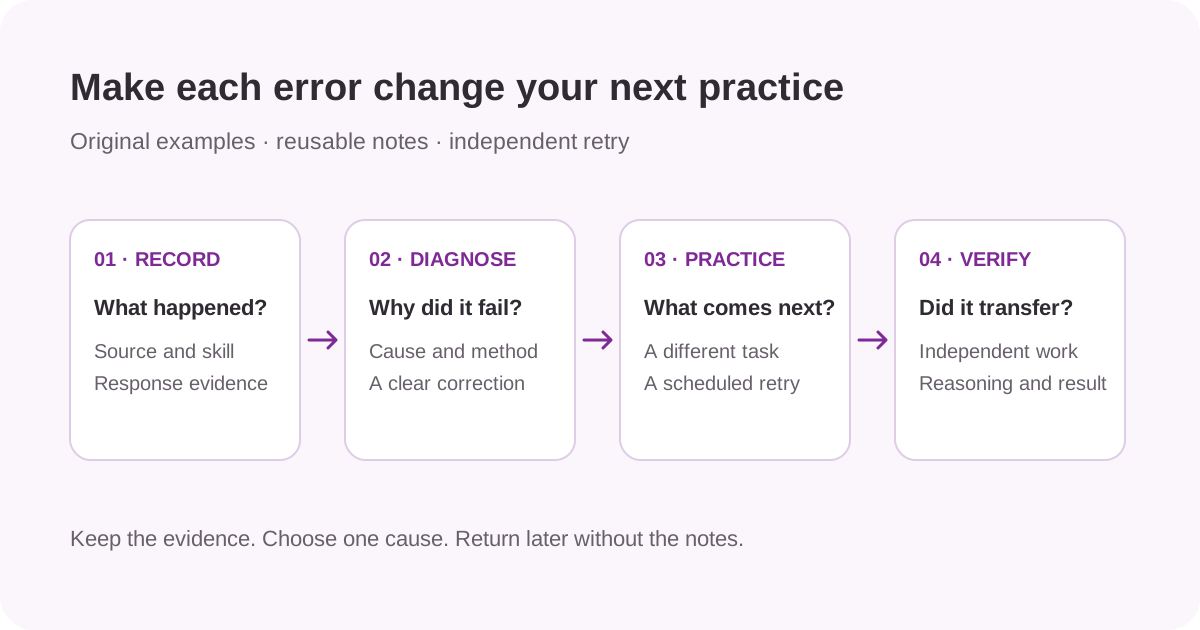
Key takeaways
- AP is a family of subject-specific exams. Use your course framework and the scoring guidelines for the exact released question; there is no universal AP error taxonomy.
- Name the course, question part and rubric requirement before deciding which practice will repair the gap.
- Use a fresh task or response for verification; remembering a reviewed answer is not enough.
- The five examples are fictional and do not reproduce official exam questions.
Build a log for your AP course
There is no single AP exam format that fits every subject. An AP error log begins with the course name and the exact released question or practice source. A Calculus justification, a History argument and a Biology experiment demand different evidence. Treat the examples in this guide as several possible course-specific rows, not as a requirement to prepare for subjects you do not take.
Use your course and exam description to name the relevant content and skill. When reviewing a released free-response question, use the scoring guidelines for that exam year and question part. A rubric requirement should not be carried into another subject or another prompt without checking it. A teacher's feedback can add detail, but your row should still make clear which response and criterion it concerns.
Record the missing reasoning or rubric evidence
Multiple-choice rows can preserve the selected answer, explanation and reasoning error. Free-response rows need a more precise reference: the question part, the requirement you were trying to meet, and the words, calculation or diagram in your response. Instead of “lost a point,” write what was absent or unsupported. A correct number without a required justification may expose a communication gap rather than a calculation gap.
Separate the official scoring guidance from your own interpretation of it. If you are unsure why a response would or would not meet a criterion, mark the row for teacher discussion. Do not invent a rubric point or assign yourself an official score from this template. The goal is an accurate revision and a future transfer task, not a favorable-looking spreadsheet.
Assign a task that matches the cause
A Biology student who names a control without explaining its purpose can annotate a new experiment's comparison. A History student who cites an example without using it in an argument can add an explanation connecting evidence to the claim. Both students need reasoning practice, but the reasoning is different. “Review the chapter” may be too broad to show whether either problem improved.
For quantitative courses, retain units, assumptions and intermediate relationships. For written arguments, retain a short excerpt of your own response and the explanation you add. Keep copyrighted official questions in their original resource rather than copying entire prompts into a shared log. A reference and your original diagnosis are usually enough to locate the material again.
Five fictional AP log entries
The table deliberately labels each AP course so that the examples cannot be mistaken for a universal exam checklist. These are invented response problems, not official prompts, scoring decisions or endorsed model answers. Adapt one row structure to your course and consult its actual scoring materials. A next-practice task should use a new stimulus or question so that success demonstrates reasoning beyond a memorized correction.
| Skill/task | Observed problem | Cause | Correction | Next practice | Later verification |
|---|---|---|---|---|---|
| AP Biology: experimental reasoning | Named a control but did not explain its purpose. | Memorized a term without linking it to the experiment. | Explain what comparison the control makes interpretable. | Annotate controls in two new experimental setups. | Write the purpose for an unfamiliar experiment. |
| AP Calculus AB: justification | Reported a value without the required theorem conditions. | Assumed a correct calculation was a complete justification. | State the relevant conditions and link them to the conclusion. | Rewrite one released response using its scoring guidelines. | Justify a new result without copying the old wording. |
| AP United States History: evidence | Provided an example without connecting it to the argument. | Treated naming evidence as explaining evidence. | Add a sentence showing how the example supports the claim. | Revise a short argument with the exact task and rubric. | Check whether a fresh paragraph explains the connection. |
| AP English Language: commentary | Repeated a quotation instead of analyzing its rhetorical role. | Confused summary with commentary. | Explain how the choice affects meaning or the audience. | Write commentary for two different short passages. | Identify a specific effect in a new passage. |
| AP Chemistry: quantitative reasoning | Used grams directly in a mole-ratio step. | Skipped the unit conversion before the relationship. | Show units through the conversion and ratio. | Solve three new stoichiometry setups with units. | Explain why each factor belongs in a later setup. |
Use a weekly course-specific review
Group only the rows from the AP course you are reviewing. Choose a repeated content gap or reasoning action, then rewrite one response with the relevant scoring guidance beside it. Explain the change without reading your previous version. Next, attempt a fresh question part that requires the same action and compare your evidence with the applicable criteria. A teacher can check uncertain judgments. Retire a pattern only when you can transfer the correction; retain difficult rows for discussion. This is an editorial study routine, not a claim about optimal spacing or a guarantee of a particular AP score.
Official resources and the next step
Check current format details with AP past exam questions and scoring materials. Use the other official sources listed with this guide for legitimate practice and criteria. Access conditions may vary, and some preparation products require payment or an account. This independent guide is not endorsed by the exam owner.
Start with the AP error log template. Fill one row from your own attempt, choose one concrete correction and schedule a fresh verification. Keep personal identifiers and complete copyrighted questions out of shared copies. Your log should make the next learning decision clearer, not promise an outcome.
Sources and methodology
AI-assisted original English editorial draft prepared in Codex on 2026-10-05. Official exam-provider pages were checked for current format and preparation guidance. The examples are fictional original learning scenarios, not copied test questions or official scored responses. The weekly review loop is a practical editorial suggestion, not a claim that a particular cadence is optimal. This guide offers no score, passing, scholarship or admissions guarantee. Human editorial review was approved by Maksim Mamchur on 2026-10-05.


