Do tutors need their own website?
As a tutor, you may be wondering if you need your own website. With so many options for reaching potential students, it can be difficult to know what is the best way to promote your services
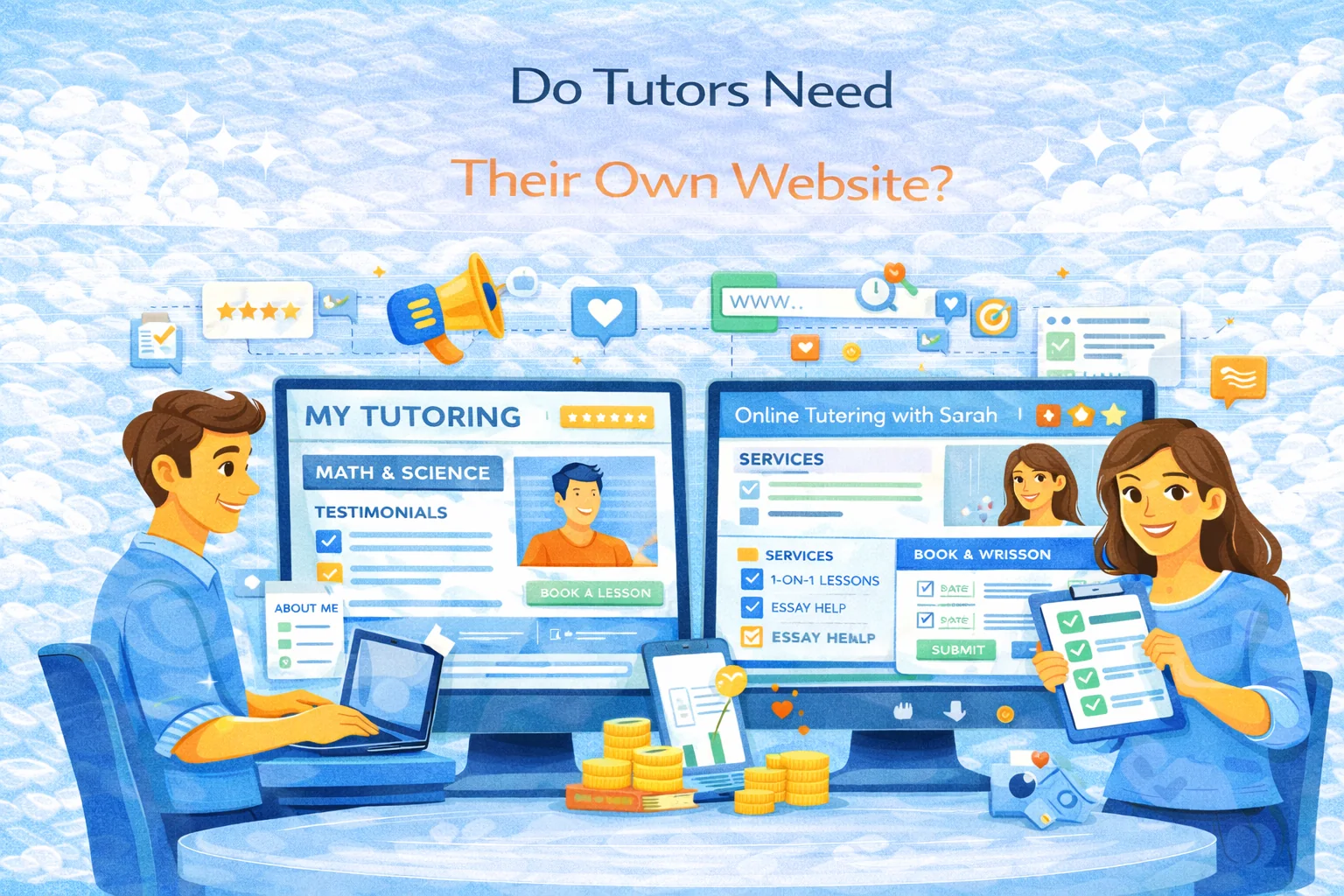
Do Tutors Need Their Own Website? (2026 Guide)
If you’re a tutor wondering “Do I need my own website?”, the honest answer is: not always. A website is useful when you need control, SEO traffic, and scalable lead generation. But if you’re still validating your niche, pricing, and offer, you can start faster with a platform page (and look just as professional).
Below is the practical breakdown (with examples, SEO tips, and a simple decision checklist).
Why tutors think they “must” have a website (and why that’s not fully true)
Most tutors want a website for three reasons:
- Trust (“I look legit”)
- Leads (“People find me on Google”)
- Sales (“Students can book/pay without chatting forever”)
A website can do all of that. The problem is: a bad website does none of it.
If it’s just “Hi, I’m Anna, I teach math” with no proof, no niche, no clear pricing, and no CTA — it’s a digital business card that no one sees.
So the real question becomes:
Do you need a website, or do you need a conversion system?
You can build the conversion system without a standalone website by using a platform profile/page (for example, your school/course pages inside SubSchool), plus social + messaging + a clean booking/payment flow.
When you do need a website
You should build your own tutor website if at least 2–3 of these are true:
1) You want Google/SEO traffic long-term
If you want students searching things like:
- “English tutor in Austin”
- “SAT Math tutor online”
- “IELTS speaking tutor”
- …to find you without ads, you need a site you can optimize with pages, content, and structure.
2) You’re building a brand (not just filling your schedule)
If your goal is to grow from “tutor” to:
- online school,
- a team of tutors,
- courses + tutoring bundles,
- a repeatable program,
- then your own website becomes the hub.
3) You sell products (courses, packages, group programs)
Courses and programs need:
- sales pages,
- structure,
- clear positioning,
- and a funnel.
You can build this inside SubSchool first (fast), and later connect a custom website when the offer is proven.
4) You need control and independence
Marketplaces can change rules, take commissions, limit your communication, or throttle visibility. Your own website is the “home base” you control.
When you don’t need a website (yet)
You can skip building a standalone site (for now) if:
1) You’re still testing your niche
If you’re not sure whether you’re:
- tutoring math vs physics,
- working with grades 6–8 vs exam prep,
- teaching adults vs teens,
- then a website is premature. Nail the offer first.
2) You’re getting clients from referrals / social / communities
If your pipeline is already warm (parents chat, local groups, word-of-mouth), the fastest win is improving conversion:
- a clean page with your offer,
- proof,
- booking/payment,
- follow-up.
A platform page is enough.
3) You don’t have time to maintain it
A website isn’t “set and forget” if you want SEO. It needs updates, content, and optimization. If that sounds like pain — don’t force it early.
What a tutor website gives you (the real benefits)
Increased visibility (SEO + search intent)
A website lets you show up for high-intent queries like:
- “online chemistry tutor for IB”
- “math tutor near me”
- “tutor for ADHD student”
- These people are already looking to pay. That’s the good traffic.
Trust at scale (proof + clarity)
A website can show:
- testimonials,
- results,
- methodology,
- your curriculum,
- examples of assignments,
- and how you run lessons.
Trust isn’t “nice design”. Trust is evidence + specificity.
More conversions (less chatting, more booking)
A good tutor website answers the questions people always ask:
- Who is this for?
- What do I get?
- How much is it?
- When can I start?
- How does it work?
- …and then gives a single obvious next step.
Better pricing power
When your offer is packaged well (website or platform page), you stop competing as “hourly tutor #918” and start selling a program.
The easiest “website alternative” that still looks professional
If your goal is “professional online presence + enrollment + payments + course structure”, start with:
- a platform page (your school + courses),
- a short link to share everywhere,
- and a simple lead intake flow.
For example, you can create course/school pages inside SubSchool and use them as your public-facing hub while you test positioning and content. That gets you a “website-like” presence without building and maintaining a full site.
If you build a website, keep it minimal (but high-converting)
A tutor website that converts usually needs 5 pages max:
- Home (who you help + outcome + CTA)
- Services (1:1, group, exam prep, packages)
- Results / Testimonials (proof)
- About (credibility + your teaching approach)
- Contact / Book a lesson (booking, form, WhatsApp/Telegram, etc.)
Optional (only if you want SEO):
- Blog (targeted search queries like “How to prepare for IELTS speaking”)
A homepage structure that works
- Headline: Outcome + audience
- “Improve SAT Math score by 150+ points with a structured weekly plan.”
- Subheadline: how it works in 1 sentence
- 3 proof points (results, experience, reviews)
- Clear CTA: book / message / trial lesson
- FAQ
That’s it. No “passion for education since childhood”. Google doesn’t pay you for feelings.
Tutor website SEO basics (so Google doesn’t ignore you)
If you want students from search, use these fundamentals:
1) One page = one intent
Don’t cram everything into one page. Make pages for:
- “Online SAT Math tutoring”
- “IELTS speaking tutor”
- “GCSE chemistry tutor”
- Each page matches what people type.
2) Use location + online variants
Even if you tutor online, location keywords help:
- “online tutor in Canada”
- “English tutor in London (online)”
- Many people search with location out of habit.
3) Add proof (Google loves this)
- Testimonials with detail
- Case studies (even 2–3)
- Before/after scores (if applicable)
- Student outcomes
4) Make your CTA stupid-simple
If people can’t tell how to start in 5 seconds, they bounce. Bounce = SEO pain.
Quick decision checklist (brutally practical)
Build a website now if:
- you want SEO leads,
- you have a clear niche,
- you have proof/results,
- you’re selling packages/courses,
- you’ll actually maintain it.
Start without a website if:
- you’re still testing your offer,
- you get leads from social/referrals,
- you need “good enough” presence fast,
- you’d rather spend time teaching/creating content.
In that “start fast” path, use a clean public page inside SubSchool as your hub (school/courses/pricing), then upgrade to a full website once your positioning is validated.
Conclusion
A website isn’t mandatory for tutors. A clear offer + trust + enrollment flow is mandatory.
If you’re early-stage: start lean (platform page + proof + CTA).
If you’re scaling: build the site for SEO and brand control.