What do you need to open your own online school?
Opening an online school can be a rewarding and lucrative venture, but it's important to carefully consider all the elements involved
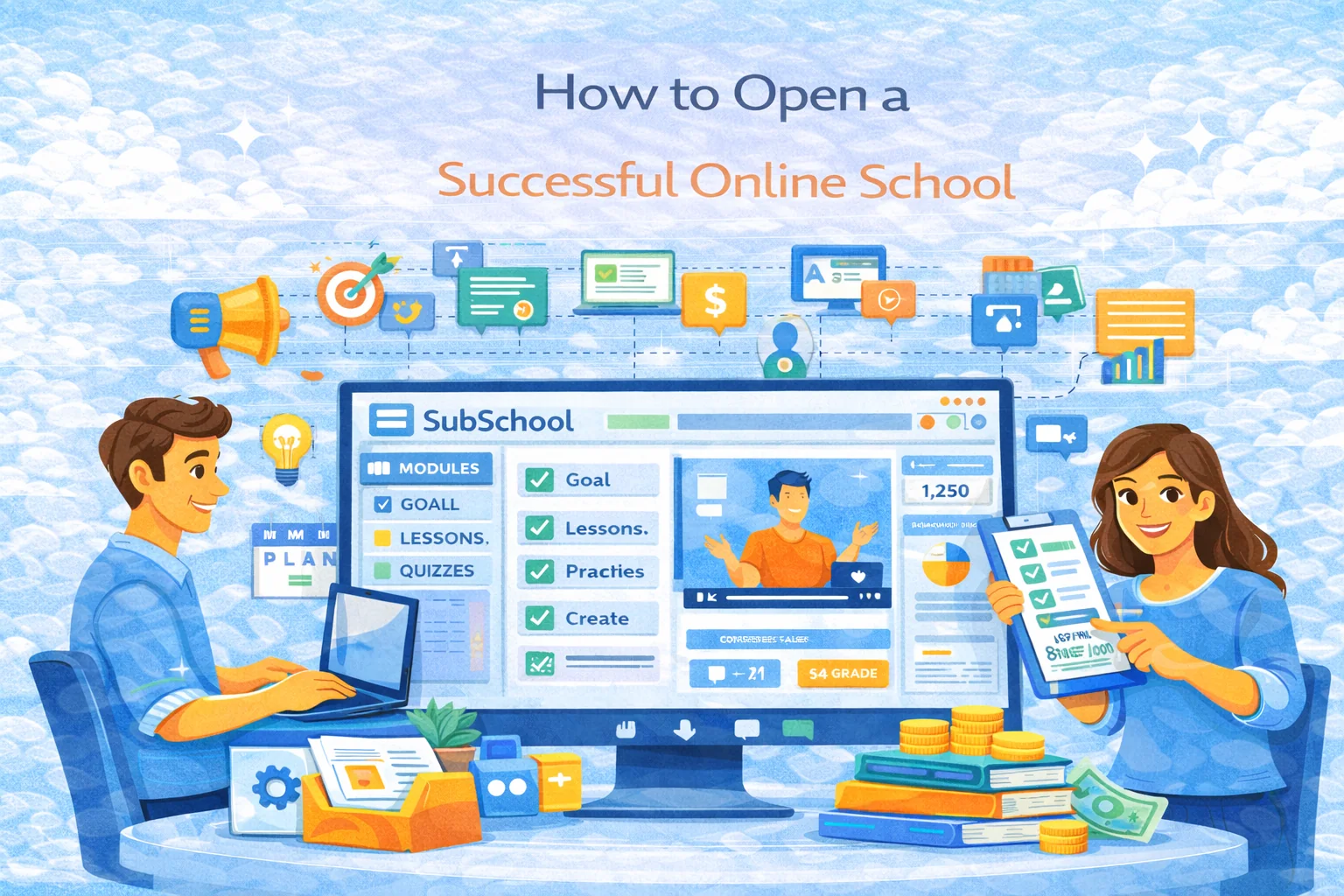
How to Open a Successful Online School in 2026
A practical, step-by-step playbook to launch, grow, and keep students coming back.
Launching an online school can be personally fulfilling and financially rewarding — but only if you treat it like a real product: clear positioning, measurable outcomes, repeatable acquisition, and a learning experience students actually finish.
Below is a modern 2026-ready guide that covers niche, platform, content, pricing, marketing, retention, and operations — with examples you can copy.
1) Determine Your Niche (and make it painfully specific)
Why it matters
“Online school” is not a niche. It’s a category. A niche is: who you help + what outcome you deliver + how you deliver it + how fast.
A simple niche formula (use this)
I help [audience] achieve [outcome] in [timeframe] using [method].
Examples:
- “I help 8th graders improve math grades from C to A in 8 weeks using daily mini-quizzes + weekly live sessions.”
- “I help entry-level accountants pass their first job interview in 14 days using case tasks + video answers.”
- “I help adult ESL learners reach B2 speaking confidence in 10 weeks using live roleplays + homework feedback.”
What makes a niche profitable in 2026
Pick niches with at least one of these:
- High stakes: exam, job, certification, admission, promotion
- Recurring need: language, math support, ongoing skills
- Clear transformation: “before → after” you can prove
- Easy segmentation: grade level, industry, role, region, exam type
Quick validation checklist
Before you build anything, verify:
- People already pay for it (tutoring, bootcamps, prep courses)
- Students have a deadline (exam date / hiring cycle / semester)
- You can define a measurable result (score, placement, portfolio, test)
2) Build a business plan that isn’t “vibes”
Why it matters
A school dies from two things: no acquisition or no retention. Your plan should explain both.
The minimum business plan (1 page)
Offer
- Who it’s for
- What outcome
- Format (self-paced / cohort / hybrid)
- Duration and workload
Unit economics
- Price
- Platform fees
- Marketing cost per student (target)
- Gross margin (target)
- Refund assumptions
Funnel
- Traffic source → lead → trial → purchase → completion → upsell
Retention
- What makes students finish?
- What makes them buy the next thing?
Pricing sanity check (fast math)
If you spend $500/month on content + tools + ads:
- Price $50 → you need 10+ sales/month just to breathe
- Price $150 → 4 sales/month = survivable
- Price $300 → 2 sales/month = workable
- Pick a price that fits your ability to drive traffic now, not “someday”.
3) Choose the right online school platform (don’t build a tech project by accident)
Why it matters
Your platform decides:
- how fast you launch
- how easy it is for students
- how well you track progress
- how well you monetize
If you want speed + simplicity + the ability to sell and manage learning in one place, use something like SubSchool.
What to look for in an online course platform (2026 checklist)
Course creation
- Modules + lessons
- Video uploads + live lesson scheduling
- Homework / exercises
- Clear structure on mobile
Assessment
- Quizzes, homework, essays
- “Entry” (placement) exams + “Exit” (final) exams
- This is gold for exam-prep and career tracks because you can show progression.
Student experience
- Simple onboarding
- Easy payments
- Works on phone (most students are mobile-first)
Monetization
- Full course + single lesson purchases
- Bundles, tiers, upsells
- Marketplace discovery (if available)
Analytics
- Completion rate
- Lesson drop-offs
- Homework submission rate
- Entry vs exit score improvements
4) Create high-quality course content (that people finish)
Why it matters
A “good” course isn’t a long course. It’s a course that creates progress fast.
Course structure that works (steal this)
Module 1: Fast win
- immediate improvement in 30 minutes
- builds trust and momentum
Modules 2–4: Core skill building
- short lessons (5–12 min videos)
- practice after every concept
- weekly recap
Module 5: Proof
- final project / mock exam / interview
- something students can show
Use “learning loops” in every lesson
Each lesson should follow:
- concept
- example
- practice
- feedback / answer key
- next step
With SubSchool you can combine videos, live lessons, and homework in a clean flow without “tech admin pain”.
5) Build assessments that increase trust (and conversion)
This is where most online schools mess up. They either:
- don’t assess at all, or
- assess in a way that doesn’t feel meaningful.
What to include (especially for exam-prep and career training)
Entry assessment (placement test)
- tells students their starting level
- helps place them into the right course
- increases conversion because it feels “personal”
Exit assessment
- proves the value
- gives you a measurable “before → after” story
Homework grading
- automated where possible
- human feedback where it matters (essays/interviews)
Essay + interview formats
- essays test reasoning and clarity
- video answers test real communication
- rewatching answers builds trust and supports hiring-style education
You can position this as:
“We don’t just teach. We measure progress.”
That line sells.
6) Build your brand so you don’t look like “random tutor #9142”
Why it matters
Students don’t buy content. They buy confidence: confidence that you’ll get them the result.
Brand essentials (minimum viable trust)
- Clear promise: “pass / improve / get hired / reach level”
- Your method in one sentence (your framework)
- Sample lesson or demo
- Proof signals: testimonials, student outcomes, your credentials, or transparent process
If you don’t have testimonials yet:
- publish student-ready artifacts: sample tests, checklists, lesson previews
- show your grading rubric
- show your curriculum map
- show your “what success looks like” standards
That builds trust before you have “big numbers”.
7) Market your online school with a simple engine (not chaos)
Why it matters
Most creators post randomly and pray. You want a repeatable loop.
The simplest marketing loop in 2026
1) One core topic →
2) Short content (TikTok/Reels/Shorts) →
3) One useful lead magnet (free placement test / free mini-lesson) →
4) Email follow-up →
5) Offer →
6) Outcome proof (entry vs exit improvement)
If your platform supports it, you can run the assessment directly inside SubSchool and convert with less friction.
Content ideas that convert (not “motivational fluff”)
- “Common mistakes that drop your score”
- “One exam trick that saves 10 minutes”
- “How I grade essays (rubric walkthrough)”
- “Mock interview: good vs bad answer”
- “Your level in 7 minutes” (placement test teaser)
8) Don’t ignore retention (it’s where profit lives)
Why it matters
Acquisition gets attention. Retention prints money.
Retention mechanics that work
- Weekly milestones (“Week 2: you can do X”)
- Progress dashboard + visible streaks
- Small homework that’s hard to skip
- Feedback cadence (even lightweight)
- Community: peer review / group discussions
Track:
- completion rate
- lesson drop-off point
- homework submission rate
- % students who buy lesson 2 after lesson 1
If completion is low, don’t “add more content”. Shorten and tighten.
9) Build operations so the school doesn’t eat you alive
What you should systemize early
- course template (modules, lesson pattern, homework pattern)
- content checklist (video, summary, practice, rubric)
- support workflow (FAQ + response templates)
- update schedule (monthly improvements)
A sane weekly routine for a solo founder-teacher
- 2 days teaching / live sessions
- 1 day content improvements
- 1 day marketing + distribution
- 1 day admin + support + analytics
That’s sustainable. Anything else turns into burnout cosplay.
Putting it all together (your launch checklist)
Week 1
- Pick niche + outcome
- Outline curriculum
- Create entry test + exit test
Week 2
- Build Module 1 (fast win)
- Create 5–10 short lessons
- Add homework + rubric
Week 3
- Publish sales page
- Post daily short content
- Drive traffic into placement test
Week 4
- Launch cohort or self-paced
- Track drop-offs
- Fix friction fast
Use SubSchool as your “do-it-now” stack: course creation + lessons + homework + assessments + student management + monetization — without you becoming your own LMS engineer.