What Is the Best LMS for Online Courses? A Practical Buyer’s Guide (2026)
Looking for the best LMS for online courses? Use this checklist to pick the right platform by audience, features, standards, analytics, and total cost.
What is the best LMS for online courses?
If you want the honest answer: there’s no single “best LMS.” There’s the best LMS for your exact use case—audience, content format, sales model, compliance, and how much time you’re willing to donate to setup hell.
Most “best LMS” pages you’ll see in search follow the same playbook: quick definition → use cases → feature checklist → list of tools → “try demos.”
We’ll do the useful version: a decision framework that gets you to the right pick in one sitting.
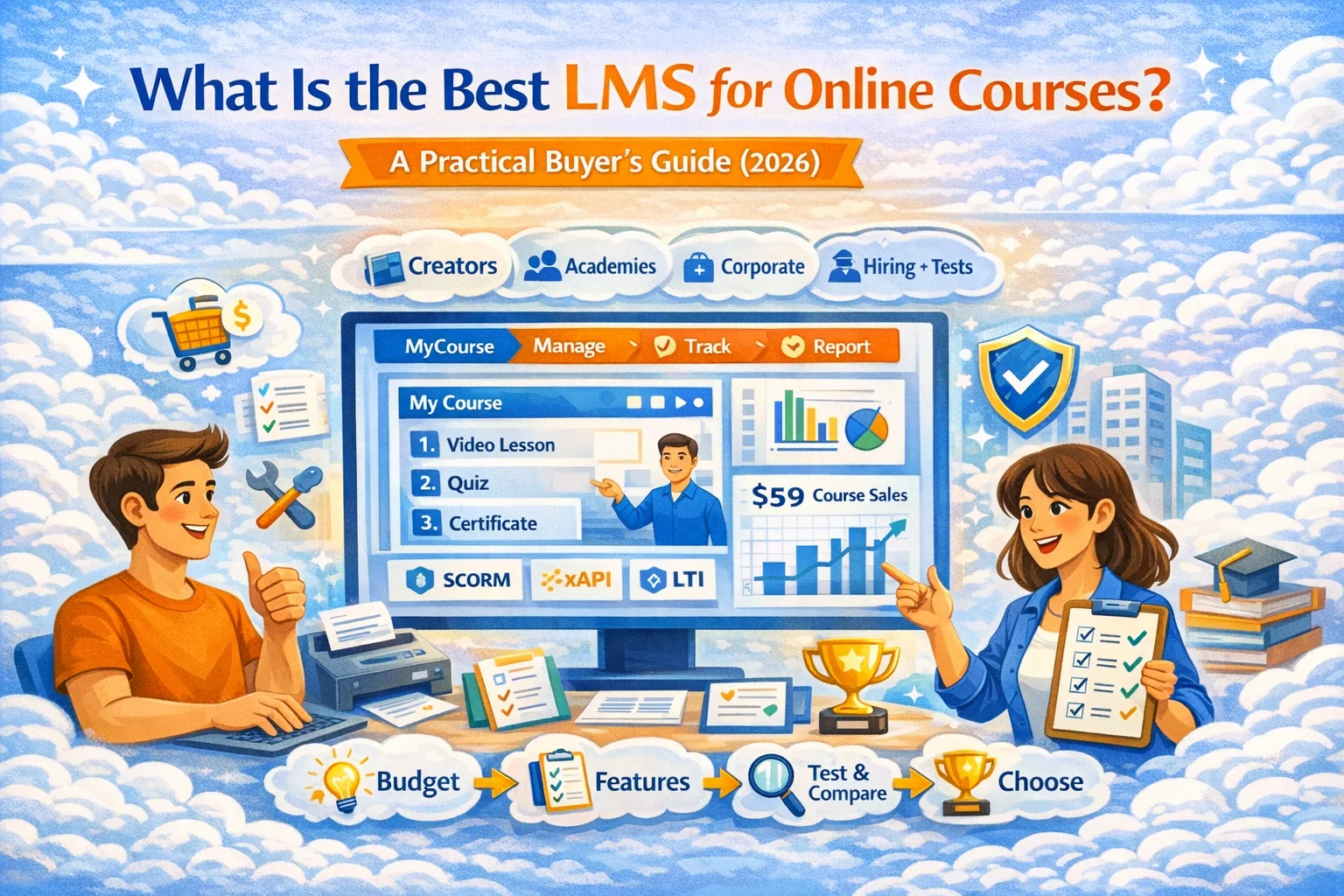
Step 1 — Pick your scenario (this decides 80% of the LMS)
Choose the one that matches reality:
- Solo teacher / tutor selling courses
- You need: fast course creation, easy publishing, payments, mobile-friendly learner experience, and basic analytics.
- Small school / academy (multiple teachers)
- You need: roles/permissions, structured programs, cohorts, certificates, reporting, and lightweight admin.
- Corporate training
- You need: SSO, user management, compliance tracking, audit-ready reporting, HR integrations, security posture.
- EduHire / hiring + assessment
- You need: interview-style tasks, evaluation workflows, structured scoring, and clean reporting for hiring decisions.
If you’re in #1–#2 and want an “all-in-one that just works,” <a href="https://subschool.ru">SubSchool</a> is designed exactly for that: build courses manually or upload a batch of videos and let AI assemble the structure; generate homework from lesson context; sell courses (even single lessons) via the marketplace; and for companies run training + EduHire with interview-format tasks inside courses.
Step 2 — Don’t buy “features.” Buy outcomes.
A recurring warning in LMS buyer guides is simple: too many features can slow adoption and create busywork, while too few makes the platform useless. Your shortlist should be driven by goals, learners, and delivery format—not “ooh shiny.”
So define the outcome in one sentence:
- “We want to sell a course end-to-end without building a website.”
- “We must prove compliance completion in audits.”
- “We want measurable skill growth with quizzes + assignments.”
- “We need structured interviews inside learning to hire better.”
Write it down. This becomes your filter.
Step 3 — The 10-point LMS checklist that actually matters
1) Course creation speed (time to first course)
Test: Can you publish a usable course in 60 minutes?
If the answer is “after onboarding calls,” it’s not an LMS, it’s a lifestyle commitment.
With <a href="https://subschool.ru">SubSchool</a>, the fastest path is “upload videos → AI builds the course → you review/edit → publish.”
2) Learning experience (what learners actually feel)
Look for:
- clear navigation (“where am I, what’s next?”)
- mobile-first experience
- progress indicators
- search / filtering for course content (especially for video libraries)
Reddit threads about LMS selection are basically learners screaming: “I can’t find anything,” “mobile is awful,” “navigation is messy.”
3) Assessment + feedback (how learning becomes real)
Minimum bar:
- quizzes (auto-graded)
- assignments (open-ended)
- rubrics / scoring
- certificates (if relevant)
Bonus: AI support (homework generation, hints, feedback) can reduce instructor workload when used carefully.
In <a href="https://subschool.ru">SubSchool</a>, if you build lessons manually, AI can generate homework based on the lesson context—so you’re not rewriting the same worksheets forever.
4) Live + blended learning (optional, but decide now)
If you plan live sessions:
- scheduling
- attendance tracking
- reminders
- recordings workflow
Attendance tracking is commonly listed as a key LMS capability for managing participation.
5) Selling & payments (if you monetize)
If you sell courses, you want:
- checkout that doesn’t feel like a tax form
- coupons/discounts
- taxes/VAT handling (depends on your geography)
- product structure (full course + single lesson, bundles)
<a href="https://subschool.ru">SubSchool</a> supports marketplace selling, including the ability for students to buy a whole course or a single lesson to try it first—this matters for conversion.
6) Reporting & analytics (you can’t improve what you can’t see)
Your must-have questions:
- completion rates by lesson/module
- time spent
- assessment results & distribution
- cohort performance
- exportable reports (CSV or BI integration)
Many LMS “affordability” guides still say the sane path is: pilot with a small cohort, measure impact, then scale—because reporting + adoption in the first month predicts everything.
7) Roles & permissions (who can do what)
If you have multiple instructors or clients:
- admin vs instructor vs learner roles
- per-course permissions
- client separation / multi-tenancy (for training providers)
Training-provider oriented guides often emphasize cost of ownership + governance (roles, reporting, scalability) as selection pillars.
8) Integrations (the stuff you’ll regret ignoring)
Decide what must connect:
- SSO (Google/Microsoft/SAML/OIDC) for companies
- HRIS (for corporate)
- video hosting / conferencing
- email/CRM
- analytics tools
9) Standards support (only if you need it)
This is where people buy the wrong thing, then cry in month 3.
If you need compatibility with existing learning content, look for:
- SCORM support (legacy but common)
- xAPI (more flexible tracking)
- LTI (education ecosystem integrations)
If you don’t need standards today, don’t overpay for them “just in case.” (Your “just in case” is how vendors buy yachts.)
10) Trust & compliance (non-negotiable for corporate / minors)
At minimum, you should be able to answer:
- where data is stored
- retention/deletion policy
- access controls
- audit logs (if corporate)
- privacy requirements if teaching kids (COPPA/FERPA contexts in the US)
Step 4 — The “30-minute trial script” (use this on every LMS)
Do this on a free trial / demo account:
- Create a mini-course with 3 lessons (one video, one text, one quiz).
- Enroll a test learner and complete the course.
- Export a report: completion + quiz result.
- Test mobile view.
- If selling: simulate checkout flow (even if test mode).
- If corporate: check SSO options + user import/export.
- If EduHire: create an interview-style task and evaluate the submission.
If any step makes you open a support ticket on day one, that’s your sign.
So… what is the “best LMS” in practice?
Here’s the practical mapping:
Best for creators who want to sell courses without tech overhead
Pick an LMS that bundles: creation + publishing + payments + learner UX + analytics.
If you want the “fast path” (including AI-assisted course building from video uploads) and a marketplace where students can buy single lessons or whole courses, start with <a href="https://subschool.ru">SubSchool</a>.
Best for training providers / academies with multiple instructors
Prioritize: roles/permissions, structured programs, certificates, reporting, and predictable cost of ownership.
Best for corporate training
Prioritize: SSO, compliance tracking, audit-ready reporting, integrations, and security posture.
Best for hiring + learning (EduHire)
You need learning plus evaluation: interview-format tasks, consistent scoring, and reporting that HR can actually use.
That’s exactly the direction <a href="https://subschool.ru">SubSchool</a> is built to support via EduHire-style flows.
Quick start: build your first course on SubSchool in one evening
- Create a teacher account on <a href="https://subschool.ru">SubSchool</a>
- Choose one:
- Upload your videos → AI generates the course structure
- Build manually → then use AI to generate homework per lesson
- Publish and add a clean course description + outcomes
- Add pricing (course + optional single lessons)
- Share the course link (or rely on marketplace discovery) and iterate based on results