
How to Create an ACT Online Prep Course (2026+): a Practical Blueprint for Tutors & Teachers
A step-by-step blueprint to build and sell an ACT prep course online—curriculum loop, homework system, practice-test workflow, and score tracking—using official ACT resources and a scalable teaching format.
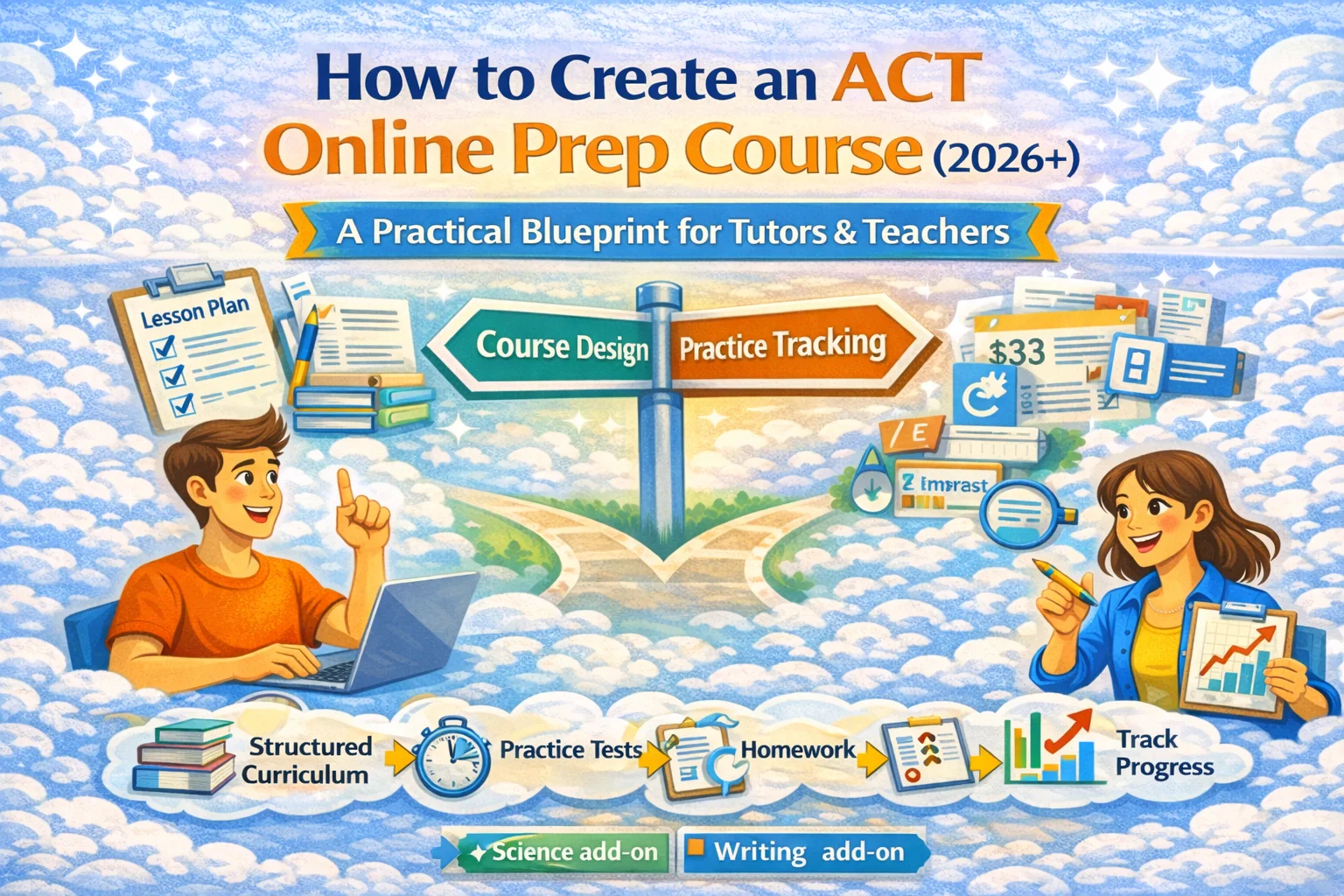
How to Create an ACT Online Prep Course: the system that gets score gains (not “watched videos”)
Most ACT prep courses fail for one boring reason: they treat the ACT like “content to cover,” not a performance to train.
Your students don’t need more explanations. They need:
- timed execution
- review discipline
- targeted drills that fix their mistakes
- a loop that repeats every week until points show up
This is the blueprint.
0) Quick sanity check: “ACT” means two totally different things online
If you stumbled onto “ACT Awareness e-Learning” — that’s counter-terrorism training in the UK, not the American college entrance test.
So yes, the internet is messing with you.
We’re talking about the ACT exam by ACT Education Corp.
1) Start with the current ACT structure (because it changed)
Before you build your syllabus, anchor to the actual test:
ACT’s official “sections & structure” page describes:
- English (50 questions / 35 minutes)
- Math (45 / 50)
- Reading (36 / 40)
- Science optional (40 / 40)
- Writing optional (1 essay / 40)
Also, ACT’s “Changes” pages explicitly describe the move toward a shorter test, more time per question, and online flexibility (including bring-your-own-device online testing), with timelines spanning national online (April 2025) and broader school rollout (Spring 2026).
Course design implication:
Don’t recycle a 2018-era ACT course outline. Build for:
- shorter modules
- faster decision-making per question
- online testing realities (fatigue, pacing, device behavior)
2) Pick your course promise (without overpromising like a clown)
A strong, honest promise formula:
“Improve by X points in Y weeks via Z system.”
Example (safe and sellable):
- “8–10 week ACT score-boost system”
- “Weekly timed practice + error log + targeted drills + checkpoints”
- “Designed for students aiming for +2 to +5 composite points” (adjust to your market)
Avoid “guaranteed score” language. You want long-term trust, not one angry parent thread.
3) The ACT Improvement Loop (this is the actual product)
Your course is not “English, Math, Reading topics.”
Your course is a repeatable weekly loop:
- Timed practice (section or mini-set)
- Review with an error log (diagnose mistake type)
- Targeted skill lesson (smallest fix with biggest impact)
- Homework drills (enough reps to change behavior)
- Retest (prove improvement)
This loop scales and produces predictable gains.
4) Course structure that works (two proven options)
Option A — 8 weeks (best “starter cohort” format)
Week 0: onboarding + baseline
- diagnostic test plan
- pacing rules
- build the error log habit
Weeks 1–6: loop weeks
Each week includes:
- 1 English skill focus (grammar + rhetoric pattern)
- 1 Math skill focus (timed problem types)
- 1 Reading focus (question mapping + timing)
- 1 timed block per section (rotating)
- 1 review session (live or async)
Week 7: full checkpoint
- full-length timed practice + deep review
Week 8: polish + test readiness
- time strategy, guessing strategy, stress plan
- final mixed drills
Option B — 10–12 weeks (best outcomes, better for lower baselines)
Same structure, but you add:
- more fundamentals (especially Math + English rules)
- 2–3 checkpoints instead of 1
5) Practice test workflow (use official ACT materials, don’t improvise “full tests”)
ACT provides free official practice tests and study guides (including full practice tests).
ACT also publishes the Official ACT Prep Guide 2025–2026 with multiple authentic tests and explanations.
And they provide online sample questions for practice.
Recommended workflow inside your course
- Week 0: show students where official practice tests live + rules for simulation
- Every week: 1 timed block (not always full length)
- Every 3–4 weeks: checkpoint test + structured review
- After each timed session: mandatory error log submission
Important: don’t copy/paste paid questions into your course materials. Use official practice for full simulations, and create your own drills for repetition.
6) The error log template (your biggest score lever)
Students improve when they stop thinking “I’m bad at ACT” and start thinking “I make these 3 mistake types.”
Columns
- Section (English/Math/Reading/Science/Writing)
- Question type (your own tag system)
- Why wrong (pick one):
- concept gap
- misread / missed keyword
- strategy error (slow method)
- careless (sign, arithmetic, bubble)
- time pressure
- Fix
- one-sentence rule
- trigger (“if I see X, I do Y”)
- drill set (10–20 items)
Run this as a required weekly assignment.
In SubSchool you can build this directly into the course as a repeating homework submission (and if you build lessons manually, AI can generate homework based on lesson context to speed up production). SubSchool also lets students buy a full course or purchase a single lesson as a “trial,” which is ridiculously good for conversion when parents are hesitant.
7) Delivery model: how to teach online without burning out
The scalable mix:
- async lessons for concepts + examples
- live sessions for review + decision-making
- homework for repetition
A practical weekly schedule:
- 2–3 short videos (8–15 min)
- 1 live session (60–90 min)
- 2 drill homework sets (30–45 min)
- 1 timed block (35–50 min depending on section)
If you do everything live, you cap your income. If you do everything async, students procrastinate. The mix wins.
8) What to do with Science and Writing (since they may be optional)
ACT explicitly lists Science and Writing as optional in its current structure overview.
So package your course like this:
- Core ACT: English + Math + Reading
- ACT + Science add-on: extra weekly timed set + strategy
- ACT + Writing add-on: 3–4 workshops + rubric grading + sample responses (your own)
This gives parents clean choices and upsell paths.
9) Build fast: the “launch in 7 days” plan
Day 1–2: outline + templates
- weekly loop
- error log
- pacing rules
- homework rubric
Day 3–7: build only Weeks 0–2
Launch enrollment. Improve the rest while running.
If you already have a video library, SubSchool can help you structure a course faster by uploading videos in batches and building around them.
10) FAQ (SEO + real questions people ask)
Is the ACT available online?
ACT’s official “Changes” pages describe national online testing and broader school/district timelines, plus flexible online options (including BYOD).
Where can students get official ACT practice tests?
ACT provides official free practice tests/study guides and practice resources.
What sections are on the ACT now?
ACT’s official structure page lists English, Math, Reading, with Science and Writing described as optional.