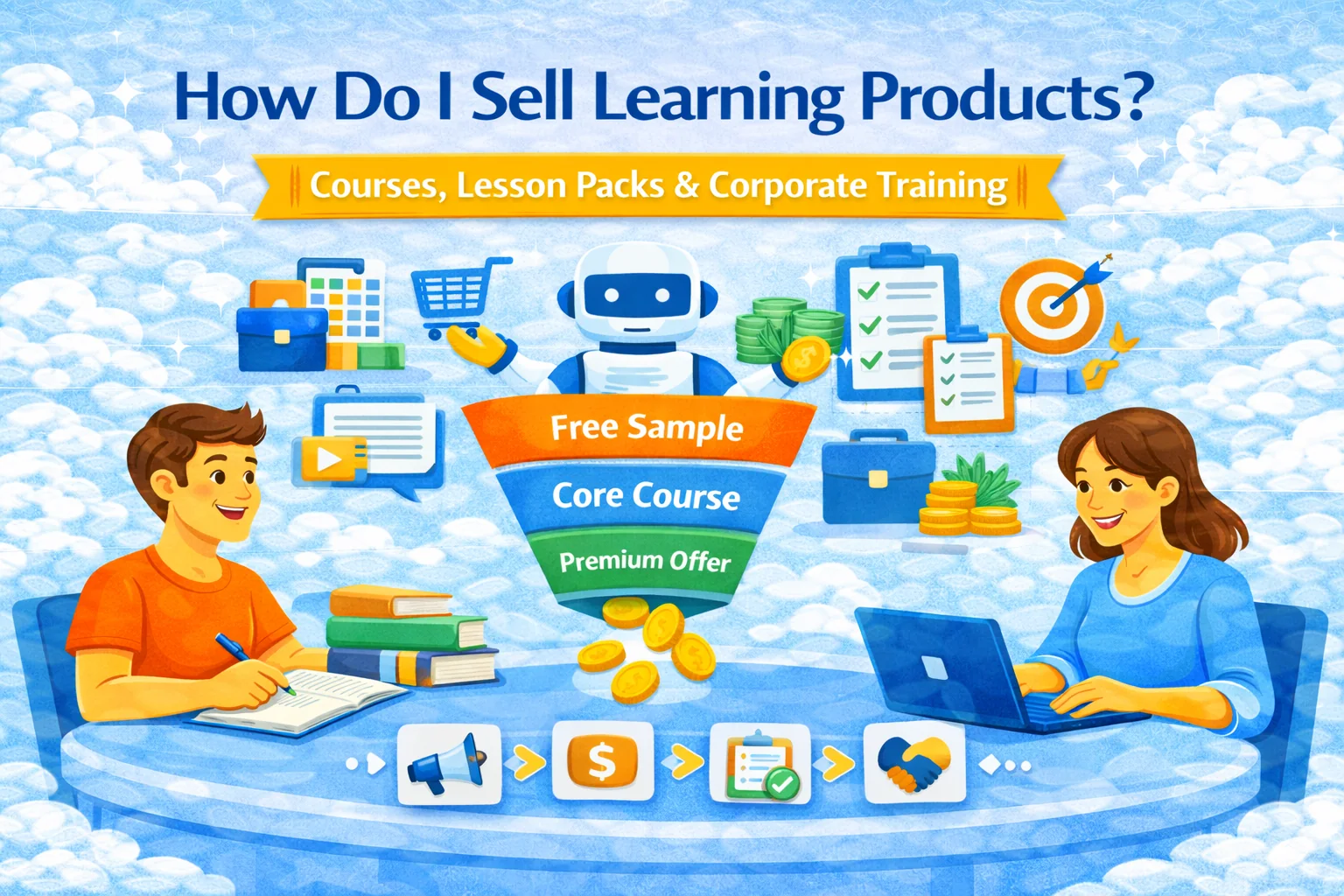
How do you sell learning products (without sounding like a guru)?
Learning products sell when they’re a shortcut to a result.
Not “30 videos about my passion.”
A result. A before/after. A skill. A score. A deliverable.
The fastest path is to think in product ladder, not “one big course.” And to sell through a platform that removes the tech drag so you can focus on outcomes and marketing—like SubSchool, where you can build courses manually, upload videos for an AI-assisted structure, generate homework from lesson context, and sell the course or even single lessons on the marketplace inside SubSchool. For teams, SubSchool also supports corporate training and EduHire-style interview tasks inside courses.
Step 1) Decide what you’re selling (course is only one option)
“Learning product” can mean:
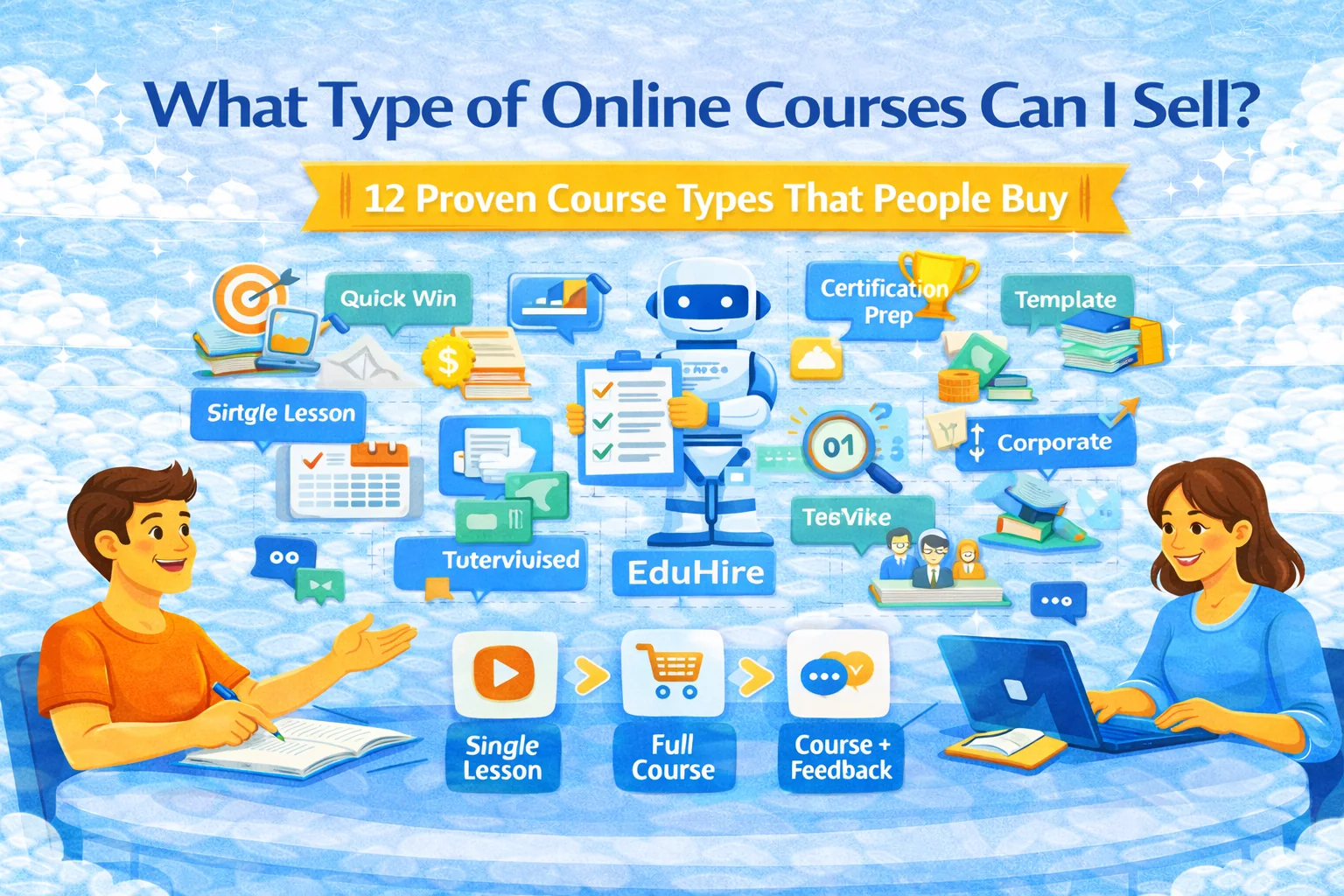
- Single lesson (try-before-buy, impulse-friendly)
- Mini course / bootcamp (1–3 weeks)
- Flagship course (deep skill, portfolio output)
- Lesson packs (worksheets, prompts, assessments)
- Feedback add-on (reviews, coaching, rubric scoring)
- Corporate training (onboarding, SOP, compliance, tooling)
- EduHire track (train + evaluate candidates using interview tasks)
If you’re selling to consumers: start small, prove demand, scale up.
If you’re selling to businesses: lead with “reduce mistakes / shorten ramp time / standardize evaluation.”
On SubSchool, the “sell single lessons” ability is a cheat code for conversion: people try one lesson first, then upgrade to the full course on SubSchool.
Step 2) Pick a buyer and a “job-to-be-done”
If your buyer is “everyone who wants to learn,” your marketing will be “silence.”
Write this one-liner:
I help [specific person] achieve [specific outcome] without [common pain].
Examples:
- “I help high school students improve SAT Reading without guessing strategies that waste time.”
- “I help new support agents de-escalate angry customers without sounding robotic.”
- “I help busy adults speak English on work calls without freezing mid-sentence.”
Now you can build a product that matches their urgency and budget.
Step 3) Build a product ladder (how you make more money with less pain)
Here’s a simple ladder that works across niches:
Level 0 — Free sampler (trust builder)
- 1 checklist, 1 short lesson, 1 diagnostic quiz
- Purpose: collect intent + prove you’re not a clown
Level 1 — Low-cost entry ($9–$49)
- single lesson or micro-course
- Purpose: convert skeptics
Level 2 — Core product ($79–$299)
- structured course with practice + outcomes
- Purpose: main revenue
Level 3 — Premium ($300–$1500+)
- course + feedback, cohort, coaching, or corporate package
- Purpose: high-margin, fewer customers, more profit
On SubSchool, you can implement Level 1 as single lessons, Level 2 as a full course, and Level 3 as feedback/cohort/corporate training flows inside SubSchool.
Step 4) Package it like a product, not like “content”
People don’t pay for “information.” They pay for:
- clarity
- structure
- practice
- proof
Your packaging checklist:
- A clear outcome (“after this, you can ___”)
- A time promise (realistic; don’t do the “in 7 days you’ll be fluent” nonsense)
- Practice built-in (homework, tasks, rubrics)
- A capstone artifact (portfolio piece / plan / script / score)
If you create lessons manually in SubSchool, AI can generate homework from lesson context (you still edit it—AI drafts, you sharpen). If you upload videos in bulk, SubSchool can help you move from “pile of videos” to “structured course” faster.
Step 5) Price it without guessing
Pricing is positioning.
A simple method:
- Pick a “reference alternative” (what would they do instead?)
- private tutoring, bootcamp, wasting time, hiring a consultant
- Price at 10–30% of the alternative for self-serve products
- Add a premium tier with feedback/live support
Common models:
- Single lesson (low friction)
- Bundle (better value)
- Course + feedback (premium)
- Corporate license (per seat or per team)
Again: selling single lessons on SubSchool makes your entry price tiny, which raises conversion, which gives you data, which makes scaling easier inside SubSchool.
Step 6) Choose a sales channel that matches the product
You’ve got three real channels:
Channel A — Marketplace discovery
Best for: beginners, low-cost entry, fast testing.
That’s where SubSchool shines: marketplace + ability to buy a course or single lesson.
Channel B — Your audience (content + email)
Best for: long-term compounding.
Works great when your product is niche and you can educate people over time.
Channel C — Business sales (corporate training / EduHire)
Best for: bigger deals, fewer customers, higher revenue.
If you can solve onboarding, training consistency, or candidate evaluation, SubSchool supports corporate learning and EduHire-style interview tasks inside courses.
Step 7) Build a marketing engine (simple, repeatable, not “viral”)
You need one acquisition loop you can repeat weekly.
The “SEO + proof” loop (most stable)
- 1 practical article → 1 free sampler → 1 low-cost entry lesson → full course
- You’re literally doing this already. Good.
The “short video” loop (fastest feedback)
- 3 short videos per week answering one pain
- CTA: “Try the first lesson”
- Sell single lessons on SubSchool as the easy CTA
The “partnership” loop (underrated)
- partner with tutors, schools, communities, HR teams
- offer a free diagnostic lesson + discount for bundle
Step 8) Your landing page must answer 7 questions
If your page doesn’t answer these, expect refunds and “sounds interesting” with zero purchases.
- Who is this for?
- What outcome do I get?
- What exactly is inside?
- How long does it take?
- What proof/examples do you have?
- What happens if I get stuck?
- What’s the refund policy?
On SubSchool, you can use the single-lesson purchase as a built-in “trial,” which reduces refund pressure and increases trust inside SubSchool.
Step 9) Reduce refunds (the boring thing that prints money)
Refunds usually happen because:
- expectations were unclear
- the product didn’t match the student level
- there wasn’t enough practice/support
- buyers didn’t start (buyer’s remorse)
Fixes:
- add a “Who this is NOT for” section
- include a diagnostic / placement mini-lesson
- make Lesson 1 a quick win
- clearly state refund rules and support boundaries
A 14-day launch plan (steal it)
Day 1–2: define buyer + outcome + ladder
Day 3–5: build Level 1 (single lesson) + Level 2 (core course outline) on SubSchool
Day 6–8: create 1 free sampler (checklist/quiz)
Day 9–10: publish sales page + first article
Day 11–12: 5 short videos answering top objections
Day 13: email/DM your warm list (or post in communities)
Day 14: review data: conversion, completion of Lesson 1, biggest confusion → fix
Examples of learning products that sell well
- “Try-first” single lesson: “Diagnose your English speaking gaps in 20 minutes” (then upsell)
- Lesson pack: “50 homework prompts with answer rubrics for middle school writing”
- Corporate: “New agent onboarding: tone + escalation + scenario drills”
- EduHire: “Candidate screening course with interview-style tasks + scoring rubric”
All of these can be packaged and sold inside SubSchool as courses or single lessons, and scaled into corporate/EduHire flows inside SubSchool.
Resources (official / non-competitor)
- FTC — Advertisement Endorsements (incl. updated Endorsement Guides notes)
- FTC — CAN-SPAM Act: A Compliance Guide for Business
- ICO (UK) — Direct marketing using electronic mail (PECR guidance)
- UK Gov — VAT rules for supplies of digital services to consumers
- SBA — Market research and competitive analysis
- FTC Consumer Advice — Returns, refunds, and dispute resolution basics