How to Start an Online School in 2026: Models, Legal Basics, Tech Stack, and a Realistic Launch Plan
A practical guide to opening an online school: pick the right “school” model, design lessons, cover core US/UK compliance basics (kids’ safety + privacy), choose a tech stack, and launch with a pilot that actually converts.
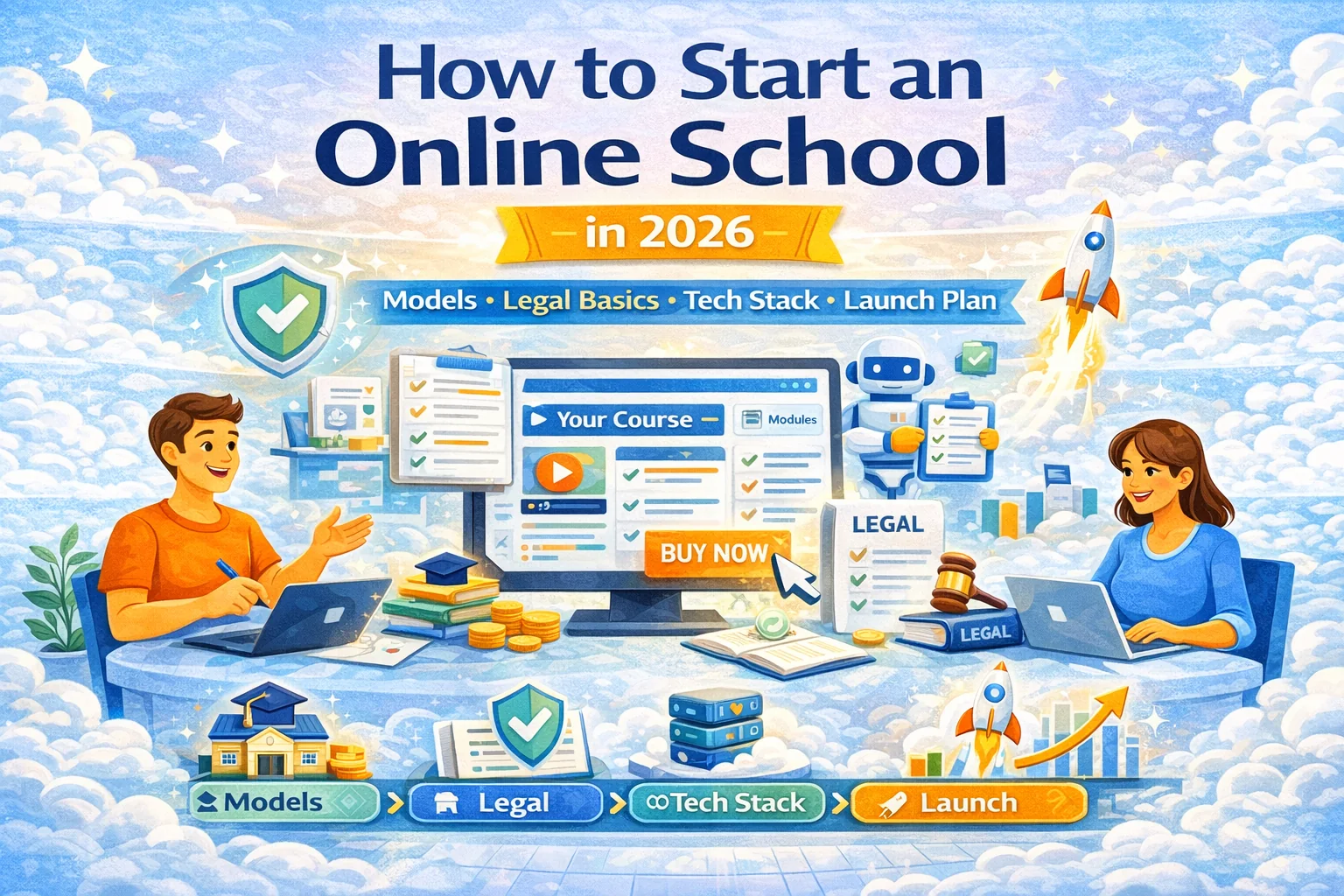
What the top “start an online school” guides cover (and what they usually miss)
Most first-page guides follow the same spine: why it’s a good idea, delivery modes, platform + content, then marketing. You’ll see frameworks like “delivery modes” and pricing structures (e.g., “night school model” etc.) and checklists like “why start / how it works / what you need / how to launch” . Others lean into planning the student journey, branding, content release (drip), and testing with a cohort .
What’s often undercooked:
- The meaning of “school” (academy vs accredited institution vs microschool) and the compliance implications.
- Kids + privacy + safeguarding when minors are involved (the stuff that can ruin your life fast).
- A launch plan that assumes you’re a human with limited time, not a content factory.
So let’s do it properly.
Step 1 — Decide what “online school” means (this choice determines everything)
There are 4 common models. Pick one on purpose:
1) Online academy (most creators mean this)
You sell skills: language, coding, SAT prep, music theory, whatever. You can issue certificates of completion, but you’re not claiming to be a regulated K-12 school.
Best for: teachers, tutors, experts.
Fastest path: use a platform like SubSchool and launch in weeks.
2) K-12 online school (regulated, heavy compliance)
You’re delivering full-time education to minors. This can trigger registration/inspection standards (especially in the UK) and high safeguarding obligations.
Best for: organizations with governance, safeguarding lead, policies, and budget.
3) Microschool / hybrid learning pod (often local-first)
Small cohort, often blended with in-person or community hubs. This has its own regulatory nuances depending on country/region and how you position it.
Best for: local operators, communities.
4) Corporate online school (internal training + hiring)
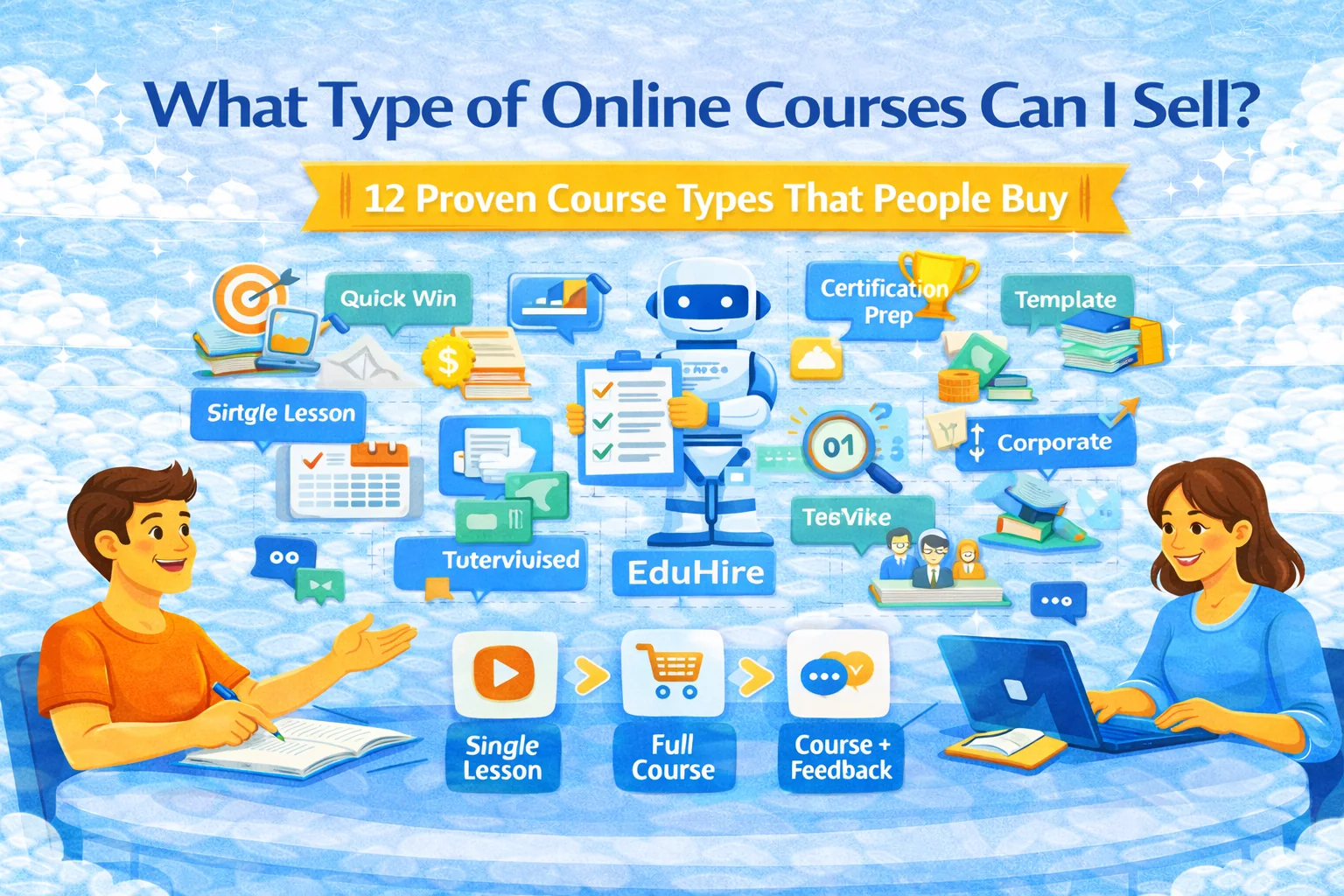
Training programs, certifications, and sometimes “hire-ready” assessment. This is where EduHire makes sense: interview-format tasks, practical assessments, and measurable competency.
Best for: companies, HR/L&D teams, bootcamps. SubSchool fits here particularly well because you can structure courses and add interview-style tasks for screening.
Brutal truth: if you’re solo or small-team, start with Model #1 (academy) or #4 (corporate pilot). “K-12 online school” is a compliance marathon.
Step 2 — Choose your delivery mode (don’t overcomplicate it)
Most guides split delivery into a few modes . In practice, you’ll pick one of these:
A) Asynchronous (recorded lessons)
Pros: scalable, flexible, low scheduling pain.
Cons: completion rates die without structure and feedback.
How to make it work:
- Lessons ≤ 10 minutes where possible (yes, even adults prefer bite-sized).
- A weekly “checkpoint” assignment.
- Simple progress milestones and certificates.
With SubSchool, you can upload a batch of videos and let AI help structure the course, and if you build lessons manually, AI can generate homework based on the lesson context.
B) Live cohorts (Zoom-style)
Pros: higher completion, higher price point.
Cons: scheduling, teacher workload.
How to make it work:
- One live session per week + async prep.
- Office hours as optional add-on.
- Clear cohort start/end dates.
C) Hybrid (best for results)
Recorded core + live practice + graded homework.
This is usually the sweet spot for outcomes and testimonials.
Step 3 — Define the “student journey” like a product manager
This part shows up in many guides as “map the student path” and identify drop-offs . Here’s the version that actually matters:
Your funnel (minimum viable)
- Landing page: who it’s for, outcome, timeline, proof
- Preview: first lesson (or single lesson purchase)
- Buy: frictionless checkout
- Onboarding: “start here” + schedule + expectations
- Progress loop: lesson → homework → feedback → next step
- Completion: certificate + next recommendation
SubSchool helps because it’s not just “course hosting”: it’s also a marketplace where students can discover and buy courses (even by single lesson), which is a strong conversion lever for skeptical buyers.
Step 4 — Compliance basics (US/UK) without turning this into a law textbook
Not legal advice — but ignoring this is how “online school” becomes “online lawsuit”.
If minors are involved, your baseline is: safeguarding + kids’ privacy
UK (England):
- Schools/colleges have statutory safeguarding duties described in Keeping children safe in education.
- There’s also specific guidance on safeguarding and remote education (live lessons, recorded video, reporting concerns, data protection).
- If you are actually operating as an independent school, registration is a formal process with required standards.
- If your service is likely accessed by children, the UK Children’s code (Age Appropriate Design Code) matters for product design and data handling.
US:
- If you collect data from kids under 13, COPPA can apply (it’s not only for “kid websites”; mixed-audience can be covered too).
- If you’re part of an educational institution handling student education records, FERPA is the big privacy law to understand (and the US Dept of Education has guidance for virtual learning).
If you plan to look like postsecondary education (certificates, credentials, degree-like claims)
In the US, “state authorization” can become relevant for certain types of institutions offering distance education.
If you’re operating across states at scale, you’ll eventually run into things like reciprocity frameworks (e.g., SARA).
Practical takeaway:
- If you’re a creator academy: keep claims clean (“course”, “academy”, “program”), avoid “accredited school” language unless you truly are.
- If you’re serving minors: invest early in safeguarding policies and privacy-by-design.
Step 5 — The tech stack: what you actually need (and what is optional)
Must-haves
- Course structure (modules/lessons)
- Video hosting + playback
- Assignments / quizzes
- Progress tracking
- Payments
- Student support channel (email/help center/community)
Nice-to-haves (add later)
- Community forum
- Certificates
- Live scheduling integrations
- Advanced analytics
- Mobile-first marketplace discovery
A minimal “don’t build a spaceship” stack
- Core platform: SubSchool (course creation + AI structuring + homework generation + marketplace sales + corporate/EduHire use cases)
- Live sessions (if needed): Zoom/Meet
- Support: a simple help center + email
If you try to stitch 7 tools together on day one, you’ll become a part-time integrator and a full-time procrastinator.
Step 6 — A realistic 30-day launch plan (pilot first, empire later)
Week 1: Define the offer
- One audience, one outcome, one promise
- “In 4 weeks you will be able to ___” (measurable)
Week 2: Build the minimum course
- 10–20 short lessons or 4 weekly modules
- 4 homework checkpoints (AI-generated homework in SubSchool helps massively here)
Week 3: Recruit a pilot cohort
- 20–30 people: discounted or free for testimonials
- Require feedback participation (non-negotiable)
Week 4: Run the pilot + measure
Track:
- Activation: % who start lesson 1 within 24h
- Completion: % who finish module 1
- Engagement: assignment submission rate
- Outcomes: before/after self-assessment + 1 practical test
- Then iterate and only then scale.
Step 7 — Common ways online schools fail (so we don’t do that)
- They call it a “school” and accidentally imply accreditation → regulatory pain.
- They sell content, not outcomes → weak conversion.
- They overproduce (100 lessons before first sale) → burnout.
- No feedback loop → low completion, no testimonials, no growth.
- Serving minors without proper safeguards/privacy posture → existential risk.
Where SubSchool fits (so the article isn’t just vibes)
Use SubSchool when you want:
- To create courses manually or upload a bunch of videos and have AI help organize them.
- AI-assisted homework generation from lesson context.
- A marketplace where students can buy full courses or single lessons (lower friction, higher trust).
- Corporate training programs and EduHire-style learning paths with interview-format tasks.
Translation: you focus on teaching + outcomes; the platform carries the “school infrastructure”.
Useful resources
- UK Department for Education — Independent school registration overview: Independent school registration
- Independent school application guidance/checklist: Application guidance and checklist
- Independent School Standards guidance (PDF): Independent School Standards Guidance
- Safeguarding baseline (England): Keeping children safe in education
- Safeguarding in remote education: Safeguarding and remote education
- Information Commissioner's Office — Children’s code: Age appropriate design code guidance
- U.S. Department of Education — FERPA + virtual learning: FERPA and Virtual Learning
- Federal Trade Commission — COPPA rule (official): Children’s Online Privacy Protection Rule (COPPA)
- State authorization regulation (US, distance ed): 34 CFR § 600.9 (eCFR)
- NC-SARA — SARA overview: SARA policy overview